The fallen world in which we live has no shortage of barriers to embracing truth. Presently, within the sea of postmodernism which we regularly swim, truth is entirely what we make it. Abortion is “family planning”, gender has far more options than well..two, and the millions of gods of Hinduism now pale in comparison to the vague spirituality custom tailored to every individual heart. It is naive to think the influence of these forces are not powerful, and greatly destructive to shrug off their infiltration of the church. In contemporary evangelical gatherings sin is rarely spoken of with any weight, repentance is softened into self-improvement, and Jesus is often presented more as a helper than a Lord who saves sinners. In a culture shaped by comfort, consumer choice, and suspicion of authority, strong claims about truth, doctrine, or obedience feel out of step. The result is a Christianity that is emotionally engaging but theologically thin—where people may attend for years without ever being taught who Christ truly is, what He has done, or why those truths must be carefully taught, preserved, and handed down.
But Christianity is not a religion of private intuition or personal improvisation. It is a God-revealed faith, entrusted once for all to the saints and handed down through the public teaching of the church. From the earliest days, believers have recognized the need not only to proclaim the gospel, but to guard it.
The New Testament itself bears witness to this impulse. Paul reminds Timothy of the “mystery of godliness” that has been confessed before the church (1 Timothy 3:16), and later charges him to “guard the good deposit entrusted to you.” Likewise, Jude explains that although he wished to write simply of their shared salvation, necessity compelled him instead to urge the church “to contend for the faith that was once for all delivered to the saints” (Jude 1:3).
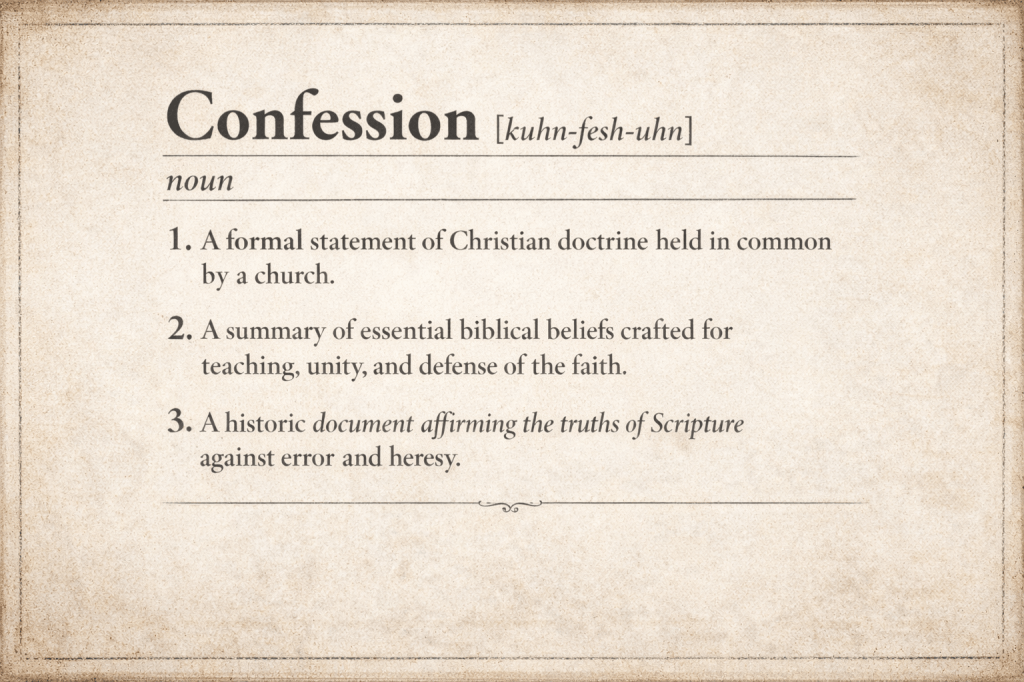
Confessionalism arises from this biblical instinct. From the first century onward, creeds and confessions were forged in moments of doctrinal crisis—not as replacements for Scripture, but as faithful summaries of what Scripture teaches. They served to protect the church from error, preserve unity in the truth, and pass on the faith intact to future generations.
Creeds of the Early Church
Between the second and fifth centuries, the early church articulated the core of Christian orthodoxy in response to heresy and confusion.
The Apostles’ Creed summarized apostolic teaching on God, Christ, and redemption. The Nicene Creed, and its later expansion at Constantinople, defended the full deity of Christ and the Holy Spirit. The Athanasian Creed provided careful Trinitarian definition, while the Chalcedonian Definition clarified the doctrine of Christ’s two natures, fully God and fully man, without confusion or division.
These were not speculative documents. They were pastoral tools, intended to ensure that the Christ preached in the churches was the Christ revealed in Scripture.
Confessions of the Reformation
The Protestant Reformation inherited this creedal instinct and expanded it. As the gospel was recovered from medieval corruption, the churches again found it necessary to confess clearly what they believed the Bible taught.
On the European continent, the Reformed churches produced the Heidelberg Catechism, the Belgic Confession, and later the Canons of Dort, together known as the Three Forms of Unity. In England, Presbyterians articulated their doctrine in the Westminster Standards: the Westminster Confession, Shorter, and Larger catechisms. Congregationalists followed with the Savoy Declaration.
Particular Baptists, emerging from the same Reformed soil, issued their own confession, first in 1644, and later the Second London Baptist Confession, adopted in 1689. Far from being an eccentric or isolated document, it intentionally mirrors Westminster and Savoy in roughly eighty percent of its wording, differing only where Baptist convictions required it.
Why the Confession Was Written
The historical context matters.
In the sixteenth and seventeenth centuries, Particular Baptists were frequently misidentified with radical Anabaptists and other sects who emphasized an “inner light” or private revelation over the written Word. Under the Act of Uniformity in England, nonconformists, including Baptists, faced persecution from both church and state.
The confession was therefore written not merely to assert Baptist distinctives, but to demonstrate continuity with the broader Reformed tradition, to refute slander, and to preserve liberty of conscience. It declared, in effect: we are not innovators; we stand with the orthodox faith of the Reformation and the ancient church.
The Need For Confessions Today
In our own day, confessions continue to serve vital purposes.
First, they remind us that we are not the first Christians who ever lived. When we confess our faith, we do so alongside the saints of all ages, grounded on the teaching of Christ and His apostles.
Second, they help settle questions of doctrine and practice. Paul commands elders to “teach what accords with sound doctrine” and to “rebuke those who contradict it” (Titus 2). But what, concretely, is sound doctrine? Confessions provide a tested, communal answer.
Third, they function as a standard of teaching and accountability, guarding the flock and promoting unity of mind and judgment within the church.
Modern evangelicalism often claims that “doctrine divides, but love unites,” seeking unity at the lowest common denominator. The results have not been encouraging. Ironically, one frequent objection to the 1689 Confession is that it is too narrow or exclusionary, despite the fact that nearly a third of it is devoted to defending Christian liberty and liberty of conscience.
Some even within Calvinistic churches would assert that the confession places hindrances from membership where the Bible does not. The confession is indeed too expansive to be a standard for who is a Christian; Scripture alone defines that. But it is not too detailed for teaching disciples to observe all that Christ has commanded (Matthew 28:20). There are varying views on the levels of confessional subscription but the aim should always be to promote unity within the congregation in submitting to the publicly stated confession of the eldership.
Confessionalism then, rightly understood, is not arrogance but humility. It is the church saying:
This is who we are, and this is what we believe the Bible teaches. This is the faith once delivered to the saints—and by God’s grace, we intend to guard it.
 Particularly Modern
“Modern evangelicalism often claims that “doctrine divides, but love unites,” seeking unity at the lowest common denominator. The results have not been encouraging. Ironically, one frequent objection to the 1689 Confession is that it is too narrow or exclusionary—despite the fact that nearly a third of it is devoted to defending Christian liberty and liberty of conscience.”
This is a very annoyingly common occurrence today. It’s also ironic that the same type of people who seek unity at the lowest common denominator approve of and pray for the church to be of one mind. Though I think it’s rarely intentional and more so that people get stuck in routine and don’t think about it. But sadly that “thoughtless routine” often times leads to spicing-up worship in order to satisfy what’s actually a hunger for more knowledge of Christ. And of course that ends up bringing you right to the very situations the confessions are designed to prevent.
LikeLike
[…] New to Confessionalism? Check out: Guarding the Faith: A Case for Confessional Christianity […]
LikeLike