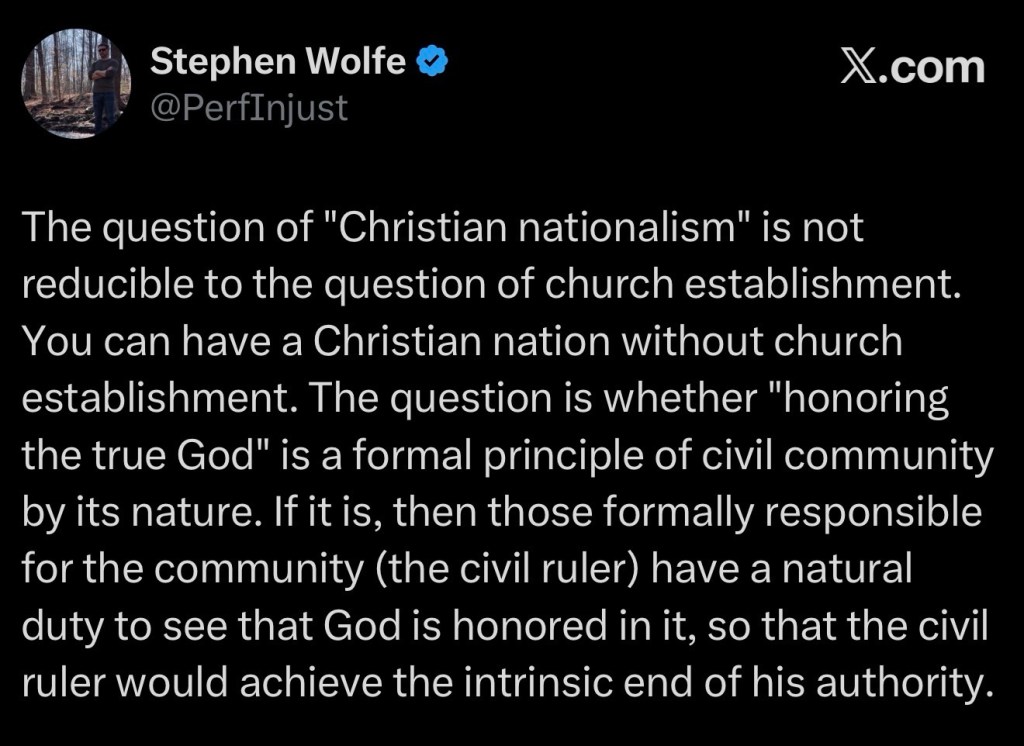
Stephen Wolfe has been among the more careful voices in the recent resurgence of Christian nationalism, and in the above post he shared on X he restated the central question plainly, and corrects a common conflation in that a Christian Nation does not demand a state-established church. This post engages that question from a confessional Particular Baptist perspective, arguing that Scripture and the Second London Confession point toward a more limited account of the magistrate’s calling than Christian nationalism tends to assume.
Wolfe has posed the question with admirable clarity: is honoring the true God a formal principle of civil community by its very nature? And if it is, does it follow that the civil ruler bears a natural duty to see that God is so honored? These are ancient questions, and they are not unworthy of careful attention. Wolfe is to be commended for distinguishing his argument from the question of church establishment, recognizing that one need not advocate for a state church in order to maintain that civil authority bears some relation to the divine order. He is right that the two questions are separable.
Yet the very framing of the question, however carefully distinguished from formal establishment, presses with its own inner logic toward conclusions that our Baptist forebears labored with great care to resist. We must take up the central question, not as mere political theorists, but as those who believe Scripture to be the only sufficient, certain, and infallible rule of all saving knowledge, faith, and obedience (1689, 1.1). And when we turn to Scripture, we discover something immediately striking: the New Testament’s political instructions were not written to a Christianized civilization. They were written to believers living under the Roman Empire, whose emperor was pagan, whose cult demanded his own deification, and whose name, in the days of Paul and Peter, was Nero. Whatever the New Testament teaches about civil government, it teaches in that context, and that context will not let us forget it.
The question, rightly put, is this: how does the civil magistrate honor God in the discharge of his office, and what are the proper boundaries of that duty?
The Magistrate’s Calling: Terror to Evil, Promoter of Good
We need not venture far into controversy before finding common ground. Paul tells us plainly that the civil ruler is God’s servant, a minister of wrath to execute judgment upon the evildoer and a source of commendation to the one who does good (Romans 13:3-4). Peter likewise exhorts submission to governors as those sent by God to punish evildoers and to praise those who do well (1 Peter 2:13-14). Here is the magistrate’s charter, written in plain apostolic terms. He is to be a terror to evil and a promoter of good.
But we must pause and feel the full weight of the context in which these words were written. Paul was not describing a Christian magistrate. He was describing Nero’s government and calling it God’s servant. Peter was not writing to citizens of a Christian commonwealth. He was writing to scattered strangers and exiles, telling them to honor the emperor. The apostles did not qualify these commands with the condition that the ruler be a believer, or that the government formally acknowledge the true God. The instructions stand regardless. This is not incidental. It tells us that the functions Paul and Peter describe, punishing evil, praising good, maintaining a framework of order in which human life can be lived, are the calling of civil government as such, not the exclusive achievement of Christian government. All rulers everywhere bear this responsibility before God, whether they acknowledge Him or not.
This matters enormously for the question at hand. If the New Testament’s vision of faithful civil government was already being fulfilled, however imperfectly, by a pagan emperor who claimed divine honors for himself, then we have strong reason to conclude that the bar God has set for civil authority is not “promote the true religion,” but something at once more modest and more universal: maintain justice, restrain wickedness, and preserve the conditions under which human communities can flourish and the church can go about her proper work.
The Witness of the Confession: The Quiet Removal of a Single Word
The Second London Confession of 1689, in its chapter on the Civil Magistrate (Chapter 24), affirms without hesitation that it is lawful for Christians to accept and execute the office of a magistrate when called to do so (24.2). Make no mistake, I am not opposed to Christian rulers. In fact, I myself am a lesser magistrate (the reason for my anonymity). There is no contradiction between Christian faith and civil office. The question is not whether a Christian may rightly govern, but what the nature and limits of that governing authority properly are.
Here we must draw attention to something of no small significance. Our Baptist fathers composed the Second London Confession with the Westminster Confession of Faith open before them. They received much of it gratefully, for it is a noble monument of Reformed theology. But they did not receive it uncritically. In the chapter on the Civil Magistrate, they made alterations that were deliberate and principled, not accidental.
The 1646 Westminster Confession (Wolfe’s standard), in its second paragraph on the magistrate, declares that rulers “ought especially to maintain piety, justice, and peace.” Three things are enumerated and distinguished: piety, justice, and peace. The Westminster Divines knew what they were doing in separating them, for they are not one and the same. Justice is the rendering to each person what is due according to law. Peace is the public tranquility and order of society. Piety is the proper worship and devotion owed to God. Westminster assigned to the civil ruler a duty in all three.
The 1689 removes piety from this list entirely. This is not an omission born of carelessness. Our Baptist forebears saw with great clarity that the duty of piety, properly understood, belongs to a different jurisdiction altogether. The civil magistrate governs by the sword; the church governs by the Word and by spiritual discipline. To assign to the magistrate the promotion of piety as part of his civil function is to muddle these two distinct spheres in a manner that has historically produced much grief, and more importantly, that finds no warrant in a New Testament written to people who were commanded to honor a deified pagan emperor as God’s servant.
The Baptists also removed the third paragraph of the Westminster Confession on this subject, which granted to the magistrate a guarding and overseeing role with respect to the church, including the duty to suppress heresy, call synods, and attend to matters affecting the church’s peace. The 1689 leaves no such power with the civil ruler. Christ alone is Lord of the conscience and Head of His church, and He has not delegated the governance of His house to Caesar. Indeed, the entire apostolic posture toward Rome suggests that the church neither needed nor expected Caesar to play such a role. She was not waiting for a Christian emperor. She was praying for a quiet and peaceable life under whatever emperor Providence had appointed (1 Timothy 2:2).
The Scriptural Testimony: Ruling in the Fear of God
What then does it mean for the civil ruler to honor God? The Scripture our Confession cites is instructive. Every proof text cited in this chapter is from the New Testament, largely quoting its exact verbiage, with the exception of two from the Old Testament. David, in his last words, spoke thus: “The God of Israel has spoken; the Rock of Israel has said to me: When one rules justly over men, ruling in the fear of God, he dawns on them like the morning light, like the sun shining forth on a cloudless morning, like rain that makes grass to sprout from the earth” (2 Samuel 23:3-4).
Mark well what is said here. The ruler is to rule justly and in the fear of God. The fear of God is the disposition of the heart from which just rule flows. It is not a programmatic religious policy imposed upon the commonwealth. It is the personal, covenantal posture of the ruler before his Maker, governing as one who knows himself accountable to the Most High. The fruit of this is justice, and the fruit of justice is something very like that morning light and refreshing rain of which David speaks: a society in which the weak are defended, the oppressor is restrained, and men may live in genuine peace. We would be immensely blessed to have such a ruler prior to Christ bringing all things into subjection to Himself.
The Confession likewise cites Psalm 82:3-4, in which God himself charges the judges of the earth: “Give justice to the weak and the fatherless; maintain the right of the afflicted and the destitute. Rescue the weak and the needy; deliver them from the hand of the wicked.” God’s charge to civil rulers here is not that they enforce the catechism or establish true worship, but that they render justice to the vulnerable and restrain the wicked. Notably, Psalm 82 is not addressed exclusively to Israelite rulers. It is addressed to the rulers of the nations, and it indicts them for their failure to do justice. The standard is universal, binding upon all who hold authority, regardless of whether they govern a covenant people or a pagan empire. This universal reach coheres precisely with what Paul and Peter assume: that God’s servant in civil matters is not necessarily God’s servant in spiritual ones.
Protestant Kings and the Question Christian Rulers Actually Raise
If the argument for Christian nationalism rests on the intuition that Christian rulers produce better government for the church and for society, then history deserves a voice in the conversation. And history is not always kind to that intuition.
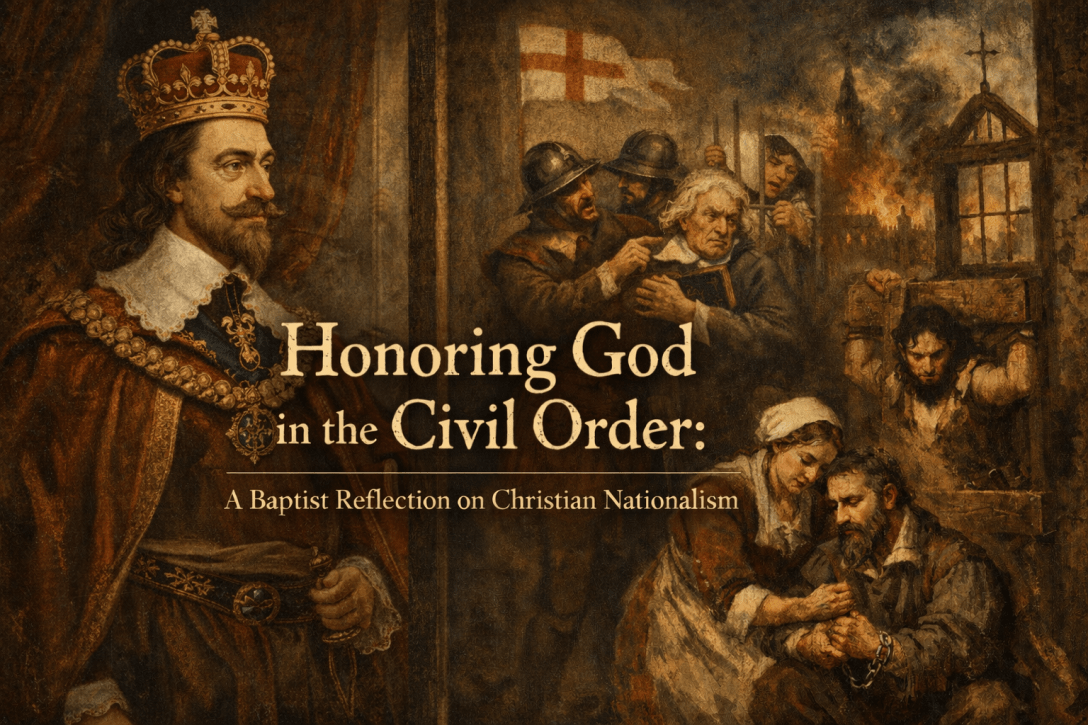
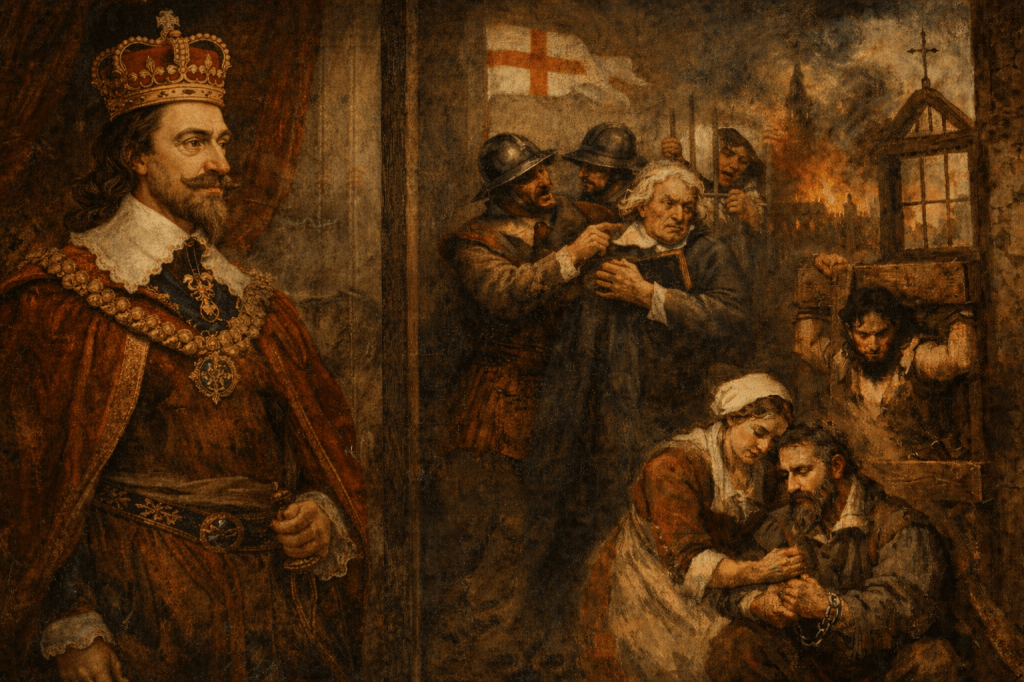
Charles I was not a nominal Christian in the way the term is used loosely today. He was a baptized, confessing Protestant, the Supreme Governor of the Church of England, a man who died with considerable personal dignity and reportedly with genuine piety. He was, by any formal measure, precisely the kind of Christian ruler that a Christian nationalist framework would regard favorably. And yet his attempt to impose Anglican conformity upon the Scottish Presbyterians helped ignite the conflict that led to the English Civil War, the convening of the Westminster Assembly, and ultimately the brief emergence of a Presbyterian settlement in England as his opponents gained the upper hand. The lesson embedded in that sequence is worth sitting with: those who suffered most acutely under Charles’ establishment vision did not conclude that establishment itself was the problem. Many concluded only that the wrong Christians were in charge.
The Particular Baptists found little comfort in that conclusion. When the monarchy was restored under Charles II, the machinery of religious coercion was not dismantled. It was redirected. The Clarendon Code, enacted between 1661 and 1665, imposed a thoroughgoing Anglican conformity through a series of acts that stripped Nonconformists of their ministries, their freedom of assembly, and in many cases their liberty. The Act of Uniformity forced around 2,000 Puritan ministers out of the Church of England, the Conventicle Act banned unauthorized religious gatherings, and the Five Mile Act barred ejected ministers from coming within five miles of their former parishes. Presbyterians, Congregationalists, and Baptists all suffered under these laws, though for different reasons and with different ecclesiastical visions. It was under Charles II that John Bunyan spent twelve years in Bedford jail, that the Particular Baptists met in secret, grew through persecution, and eventually produced the Second London Confession of 1689 (only after the passing of the Act of Toleration the same year) as a testimony of their convictions forged in suffering.
Charles II was no less Protestant than his father. The Clarendon Code was not the work of a pagan emperor indifferent to religion. It was the work of an explicitly Christian monarchy determined to enforce religious uniformity in the name of order and true religion. And what it produced, for those outside the establishment, was oppression.
Now consider a hypothetical that is not difficult to construct in the present age. Imagine a president who makes no strong claim to Christian faith, or whose Christianity is plainly nominal, but who governs with a genuine commitment to civil justice: who upholds the rule of law, defends the vulnerable, restrains corruption, and maintains the conditions under which all citizens, including Christians, may worship freely and live peaceably. By the standard Paul sets in Romans 13, by the standard Psalm 82 applies to all rulers, and by the standard the Second London Confession articulates for civil office, that president has fulfilled his calling. The church under his administration may pray, preach, plant, and disciple without hindrance. This is the life the Apostles instruct us to pray for.
Which of these rulers better served the church of Jesus Christ? The answer is uncomfortable for those who assume that Christian identity in the magistrate is the variable that matters most. The Stuarts wore the faith as a crown and used it as a weapon. The just ruler who simply does his civil duty and leaves the church alone may render to her the only thing she ever needed from Caesar: to be left alone to do her work.
This is not an argument against Christians serving in civil office. It is an argument about what civil office actually is and what it actually requires. A Christian magistrate who understands the limits of his calling, governs justly, and refuses to confuse his civil authority with spiritual oversight is a great gift to any commonwealth. But his Christianity is expressed precisely in his willingness to govern within those limits, not in his ambition to extend them.
The Logical Pressure of Wolfe’s Framing
Let us return to Wolfe’s formulation. He asks whether honoring the true God is a formal principle of civil community by its nature. If we answer yes, and then ask how the civil ruler fulfills this duty, we find ourselves pressed almost irresistibly toward something beyond mere personal piety in the ruler, and toward some formal public acknowledgment and promotion of true religion. And once we arrive there, the question of what “true religion” means in practice, and who defines and enforces it, does not remain abstract for long. History answers it for us, and the answer bears the names of men like Bunyan, Helwys, and the countless Nonconformists who filled English jails under explicitly Christian kings.
It is worth pressing this point from the other direction as well. If promoting true religion is the intrinsic end of civil authority, then the apostolic instructions to submit to and honor a pagan emperor become extraordinarily difficult to account for. Paul was not simply counseling pragmatic accommodation to an unfortunate situation. He was grounding the magistrate’s authority in the ordinance of God (Romans 13:1). If that ordinance is intrinsically bound up with promoting the true God, one struggles to understand how it could be genuinely fulfilled, even partially, by a man who sacrificed to Jupiter and accepted divine honors for himself. And yet Paul says it was. The Roman magistrate was, in some genuine sense, God’s servant in his civil function, even in his paganism. This does not vindicate paganism. It clarifies the nature and limits of the civil calling.
Thomas Helwys, that early forerunner of the Baptist witness (died in prison under James I), argued in words remarkable for his age that the king, being a mortal man and not God, has no power over the immortal souls of his subjects. The soul’s commerce with God lies beyond Caesar’s jurisdiction, not because God is unimportant to public life, but because the New Testament has established a new and different order for the governance of Christ’s kingdom, one that operates not by compulsion but by the free proclamation of the Gospel.
What the Baptist Confession Truly Envisions
What then is the Baptist vision? Is it synonymous with the vision represented in Apostolic instruction? It is not a godless state, nor a ruler indifferent to his Creator. The Confession envisions Christians occupying civil office and discharging it faithfully, ruling in the fear of God as 2 Samuel 23 enjoins. It envisions a magistrate who protects the peace of all his subjects, including the freedom of the church to worship and preach without molestation. It envisions justice administered without respect of persons. These are the civil ruler’s proper calling, and they are, rightly understood, a genuine form of honoring God.
Crucially, this vision does not depend upon the ruler being a Christian to be valid. The Confession does not say that only Christian magistrates can fulfill this calling, only that Christian magistrates may and should. The standard of just rule, the fear of God expressed in equity and the defense of the vulnerable, is the standard for all rulers everywhere. What a Christian ruler brings to that office is not a different set of governmental duties, but a regenerate conscience, a genuine knowledge of God, and a personal accountability to Christ that deepens and clarifies what he was already obligated to do by virtue of his office. He does not transform the nature of civil government. He can (or fail to) fulfill its existing obligations more faithfully and with greater understanding of why they matter.
The magistrate has no authority over the church’s doctrine, worship, or discipline. He may not compel religion, nor suppress the worship of those who dissent from any established order. His authority is for civil matters: life, property, public order, and the punishment of wickedness in its outward and socially harmful forms. He is not Christ’s vicar in ecclesiastical matters, and he is not the enforcer of the first table of the law in the same manner that he enforces the second. The church of the first century did not petition Nero to become her guardian. She prayed that under his reign, or any reign, she might lead a quiet and peaceable life in all godliness and honesty, and she went about the work of the Gospel without waiting for imperial endorsement.
A Call to Order
The questions raised by Wolfe and those who labor with him in political theology are not trivial. We do well to think carefully about the proper ordering of civil life, and to resist any drift toward a naked secularism that would expunge all reference to God from public reasoning. Christians in civil office ought to govern in the fear of God, in dependence upon His wisdom, and with His law written on their consciences.
But the New Testament’s own political theology was forged under Caesar, not under David. Its instructions to believers were not contingent upon having a Christian ruler, and its vision of what civil government owes to God was not expressed as a program for Christianizing the empire. It was expressed as a call to justice, order, and peace, a call that rested upon all rulers alike, and that the church could recognize even in those who knew not the Gospel.
The magistrate should wield his authority with justice and in the fear of God, whatever his personal confession may be. Let the church preach the Word faithfully and freely, under friendly governments and hostile ones alike. And let us resist the temptation to so entangle these two callings that the faithfulness of the one comes to depend upon the cooperation of the other. Christ’s kingdom has never needed Caesar’s sword to advance it, and history gives us little reason to think it has ever benefited when Caesar has tried.

 Particularly Modern