In many modern circles devoted to the resurgence of “biblical manhood and womanhood,” a subtle but troubling pattern has emerged. Women, particularly wives and mothers, are increasingly painted in terms more cultural than biblical: domestically cloistered, perpetually bread-making, modest in the style of rural Mennonites, and almost entirely defined by the hearth. It is not uncommon for such imagery to be coupled with a rigid interpretation of Titus 2, where the call to be “keepers at home” is read in isolation from the rest of Scripture, giving the impression that a godly woman’s value begins and ends at her kitchen counter.
Make no mistake, there is nothing dishonorable in such domestic attentiveness. Scripture dignifies the home as a place of industry, nurture, and gospel fruitfulness (Proverbs 31:10–31). But when this particular image of womanhood is absolutized—when the roles of women are artificially narrowed to a culturally nostalgic archetype and upheld as the only biblical vision—we are no longer dealing with sola Scriptura. We are dealing with reactionary traditionalism, not reformational fidelity.
This essay contends that what some call “exceptions” in Scripture: women like Deborah, Huldah, Jael, Priscilla, Phoebe, Lydia, Anna, and others, are not breaches of God’s moral order but instructive manifestations of His wise providence. To treat such examples as regrettable anomalies is to risk accusing God of violating the very righteousness He commands. Instead, the biblical witness calls us to a fuller, more textured understanding of male and female roles that honors God’s design, affirms His holiness, and resists both the subversions of feminism and the distortions of overreaching patriarchy.
The Theological Problem
We begin with a crucial theological distinction: the difference between what God decrees (His secret will) and what He prescribes and approves (His revealed or prescriptive will). All things that come to pass are within God’s sovereign decree (Ephesians 1:11), but not all things are in accordance with His moral approval. God permits and overrules evil for good (Genesis 50:20), but He never condones, commands, or morally sanctions what is unrighteous.
The pressing question is: can God, in His revealed will, commend or appoint someone to a role that would be morally impermissible were it self‑chosen? That is: can God impose or sanction an authoritative role that contravenes His own moral law?
The answer must be an unqualified no.
“The Rock, his work is perfect, for all his ways are justice. A God of faithfulness and without iniquity, just and upright is he.”
—Deuteronomy 32:4
“You who are of purer eyes than to see evil and cannot look at wrong…”
—Habakkuk 1:13
If God raises up a woman such as Deborah, and Scripture not only fails to condemn her service but records it with approval, then this must be understood as part of God’s righteous ordering—not a moral anomaly.
To suggest otherwise is to imply that:
- Deborah sinned by accepting her role (though Scripture never rebukes her); or
- God sinned by appointing her (an impossibility); or
- God suspended His moral order for expediency (which denies His immutability).
John Owen writes:
“Whatever is contrary to the law of God’s nature, as being holy, just, and good, He can neither approve nor prescribe. For what He commands is not only good because He commands it, but He commands it because it is good.”
Vindiciae Evangelicae (1655)
Thus, if God prescribes or appoints women to roles of influence or authority in Scripture, this cannot be morally irregular…it must be righteous.
Deborah, Huldah, and the Nature of Spiritual Authority in Civil and Prophetic Roles
Deborah judged Israel (Judges 4:4–5), more akin in power to a queen than what we would understand as merely a jurisdictional magistrate. She delivered the word of the Lord to Barak and led the nation in righteous judgment and battle. Scripture never hints at rebuke. Instead, the inspired song of Deborah exalts her as one whom the Lord raised up in faithfulness: “The villagers ceased in Israel; they ceased to be until I arose; I, Deborah, arose as a mother in Israel.” Judges 5:7
Huldah the prophetess was sought by high-ranking officials in the days of Josiah (2 Kings 22:14–20). Her word from the Lord was decisive and canonically received. Her calling was not questioned; it was honored as genuine divine revelation.
Anna the prophetess bore witness to Christ in the temple and “spoke about the child to all who were looking for the redemption of Jerusalem” (Luke 2:38). Her public proclamation was Spirit-filled praise.
These women spoke the Word of God to men, exercised spiritual influence, and carried out roles of public significance. Yet none held the teaching office of the gathered church as regulated by apostolic instruction. Their ministries display the breadth of God’s gracious use of women without violating God’s order in the church.
Prophecy, the Teaching Office, and the Role of Women in the New Covenant
A frequent misunderstanding arises when the term “spiritual authority” is used without defining its boundaries. The Bible distinguishes between prophecy and the teaching office of the church.
In the Old Covenant, prophetesses were recipients and bearers of divine revelation. In the New Covenant, the apostle Paul affirms that both men and women may prophesy publicly in worship (1 Corinthians 11:4–5) but also regulates that authoritative teaching over men in the gathered church belongs to qualified men (1 Timothy 2:12; 3:1–7). This is not contradictory; it reflects different functions.
Prophecy, even in the New Testament, is a Spirit-empowered utterance meant for edification, exhortation, or consolation (1 Corinthians 14:3). It does not entail doctrinal exposition with binding authority over the church in the way the eldership does. Paul’s concern in 1 Corinthians 11 is that women who pray or prophesy do so in a way that honors headship and the order of worship.
Thus, women who prophesied, such as Philip’s four daughters (Acts 21:9), exercised a gift of the Spirit that built up the church, without trespassing into the teaching office reserved for qualified elders.
Headship, Not Universal Hierarchy
Scripture teaches male headship in specific spheres:
- The home: “The husband is the head of the wife even as Christ is the head of the church” (Ephesians 5:23).
- The church: “I do not permit a woman to teach or to exercise authority over a man” (1 Timothy 2:12).
But Scripture does not teach male headship as a universal prerequisite for every sphere of society. The Proverbs 31 woman buys land, sells goods, leads servants, and speaks wisdom publicly — all without compromising her submission to God and her husband.
“The woman was made of a rib out of the side of Adam; not made out of his head to rule over him, nor out of his feet to be trampled upon by him, but out of his side to be equal with him, under his arm to be protected, and near his heart to be beloved. Adam lost a rib, and without any diminution to his strength or comeliness; but in lieu thereof he had a help meet for him, which abundantly made up his loss: what God takes away from his people he will, one way or other, restore with advantage.”
—Matthew Henry
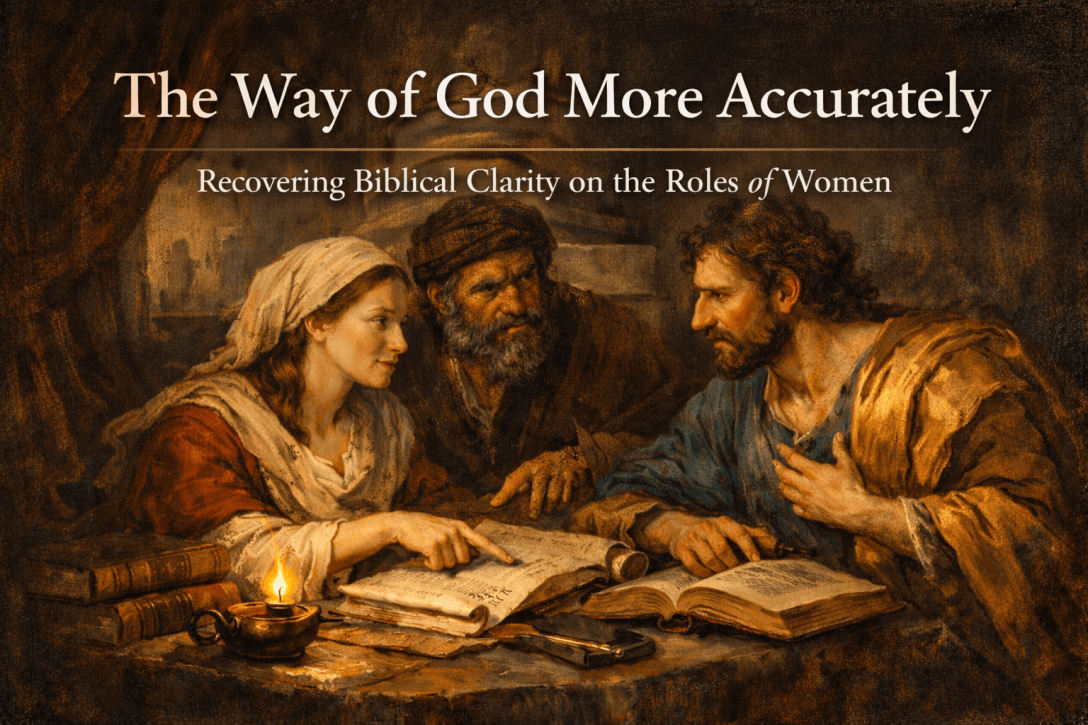
Women like Lydia (Acts 16), a merchant whose household became a church base; Phoebe (Romans 16:1–2), commended as a servant and benefactor of many, exemplified faithful leadership and initiative under God’s design; and Priscilla (Acts 18), who with her husband Aquila explained “the way of God more accurately” to Apollos.
Some object that any correction or theological instruction offered by a woman to a man necessarily violates Paul’s command that women “not teach or exercise authority over a man” (1 Tim. 2:12). Yet the example of Priscilla correcting Apollos, alongside her husband, in private, and for his benefit—contradicts this absolutism.
As Matthew Henry wisely observes:
“Apollos, though he was instructed in the way of the Lord, did not rest in the knowledge he had attained, nor thought he understood Christianity as well as any man (which proud conceited young men are apt to do), but was willing to have it expounded to him more perfectly. Those that know much should covet to know more, and what they know to know it better, pressing forward towards perfection. Here is an instance of a good woman, though not permitted to speak in the church or in the synagogue, yet doing good with the knowledge God had given her in private converse.”
—On Acts 18:24–26
Henry’s pastoral insight captures the spirit of the text: humble teachability in the hearer, and quiet faithfulness in the teacher, even if she be a woman not holding ecclesial office. The church today would do well to remember this balance.
Objections Answered
“Titus 2 restricts women to the domestic sphere.”
Titus 2 calls women to be “workers at home” (οἰκουργούς)—that is, attentive and faithful in household responsibilities. This does not prohibit public engagement, commerce, or ministry. The Proverbs 31 woman harmonizes domestic faithfulness with enterprise and benevolence.
“Public service by women undermines male leadership.”
Only when such service is exercised in defiance of God’s established order. Deborah exhorted Barak rather than usurping his role. Huldah’s word was solicited and honored. Priscilla taught in partnership with her husband. These women strengthened covenant life without subverting God’s ordained spheres of authority.
“Female leadership is always a judgment from God.”
This argument, often more from assumption than exegesis, is drawn from Isaiah 3:12, where the Lord, through His prophet, announces judgment upon Jerusalem and Judah:
“My people—infants are their oppressors, and women rule over them.” (ESV)
This passage indeed speaks of societal disorder, of a nation under God’s chastening. Yet it is a grave error to take this as a universal maxim: that the mere presence of a woman in authority is itself always a sign of divine judgment. Let us consider why.
Isaiah 3 is descriptive of a specific judgment, not prescriptive of a universal moral principle. The passage describes a situation where the competent men of Israel have been removed (cf. Isa. 3:1–4), leaving the people in a state of chaos. The issue is not womanhood, but the absence of wise, courageous male leadership in a covenant-breaking society. The mention of women ruling is symptomatic, not prescriptive.
Isaiah 3 does not nullify God’s approval of female leaders elsewhere. If all female rule is always judgment, then how do we explain Deborah, raised up and blessed by God to judge Israel and prophesy in His Name (Judg. 4–5)? Or Huldah, to whom even the king’s men turn for a true word from God (2 Kings 22)? Were these women God’s judgment—or God’s instruments of mercy? If we treat all female leadership as ipso facto judgment, we are compelled to say that God prescribed and praised what He elsewhere condemns, a contradiction in His moral will, which is impossible.
God cannot commend unrighteousness. It is a category error to take one judgment passage and universalize it as a moral norm. By the same logic, we might say that all children are evil rulers because Isaiah 3:4 says, “I will make boys their princes.” But Scripture praises Josiah, who became king at eight (2 Chron. 34:1–2), and Timothy, who was exhorted not to let others despise his youth (1 Tim. 4:12). The presence of women in leadership in Isaiah 3 is a sign of disorder under a faithless covenant people. The presence of women in leadership under God’s calling and approval (as with Deborah or Huldah) is a sign of divine faithfulness, and sometimes of male weakness or dereliction, but never of divine compromise or contradiction.
Even if a woman’s rise is occasioned by male failure, it does not render her leadership sinful. When Barak hesitated, Deborah stepped forward (Judg. 4:8–9). The shame rested not on her obedience but on his cowardice. Likewise, in times of spiritual famine, God raises up those who will be faithful, not always those who were expected to lead. The Reformers taught that necessity does not abrogate God’s moral law; rather, it is in times of necessity that the true character of obedience is most clearly revealed.
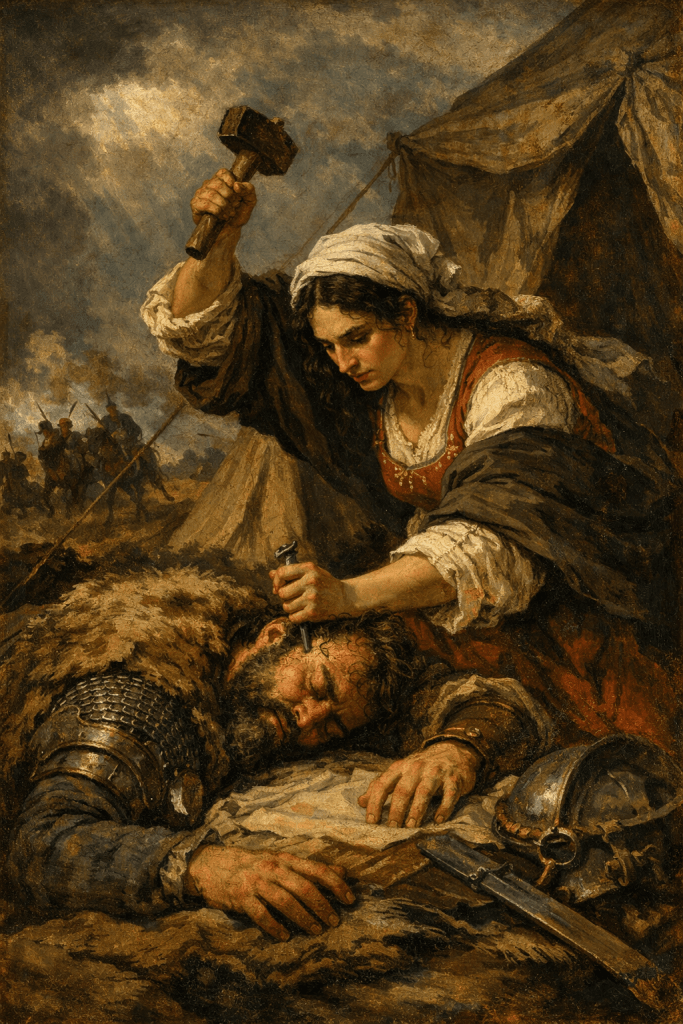
A 16th century painting of a lowly pastor’s wife crocheting a doily
A More Excellent Way: Biblical Balance Restored
The biblical vision for male and female service avoids the extremes of feminism’s rebellion and patriarchal overreach:
- Men and women bear equal worth as image‑bearers of God (Genesis 1:27).
- God ordains male headship in the home and church.
- The Spirit bestows gifts to both men and women for the edification of the church (1 Corinthians 12:11).
- Women may exercise ministry, teaching in appropriate contexts, leadership, hospitality, prophecy, and public influence, so long as such roles do not contravene God’s clear boundaries for eldership and doctrinal authority.
Conclusion
The Scripture does not need our hedges. It is clear where it binds, and wise where it is silent. Our Particular Baptist forebears, steeped in the Word and guided by the Spirit, taught us that God’s moral order is never arbitrary, that His Spirit distributes gifts as He pleases, and that every member of Christ’s body, male or female, slave or free, is called to build it up in love.
Modern feminism rejects the created order, despises male headship, blurs or erases distinctions between the sexes, and exalts personal autonomy over divine authority. It encourages women to view the home as bondage, children as hindrance, and submission as oppression. Such rebellion must be firmly opposed. But we sin just as truly when, in reacting against it, we deny what God has clearly affirmed. Scripture calls us neither to feminist revolution nor to fearful suppression, but to joyful, ordered obedience where men lead in love, and women flourish in every good work the Spirit appoints.
In the home, the husband must lead with sacrificial love; the wife must adorn the doctrine of Christ with good works and glad submission. In the church, the office of elder is entrusted to qualified men. But the work of the church—prayer, hospitality, evangelism, instruction of the young, care for the weak, exhortation of the saints, is the shared domain of all who are filled with the Spirit.
Let us not treat as mere “exceptions” those whom God has honored as examples. Let us resist the temptation to make our personal preferences into divine law. Let us not muzzle Priscilla, nor sideline Phoebe, nor forget that our Lord was pleased to send the first tidings of His resurrection by the mouths of women.
As John Owen wisely wrote:
“The edification of the church consists in the increase of faith and obedience in all the members thereof, in the subduing and mortifying of sin, in fruitfulness in good works, in the confirmation and consolation of them that stand, in the raising up of them that are fallen, and the recovery of them that wander, in the growth and flourishing of mutual love and peace; and whatever rule is exercised in the church unto any other end is foreign to the gospel, and tends only to the destruction of the church itself.
—The Holy Spirit
And let us also heed the words of Susannah Spurgeon, who saw in God’s providence not frustration but mercy:
“It is a mercy that our lives are not left for us to plan, but that our Father chooses for us; else might we sometimes turn away from our best blessings, and put from us the choicest and loveliest gifts of His providence.”
A more excellent way awaits us: the path of humble fidelity to Scripture, joyful submission to Christ’s order, and full-hearted welcome of every good gift He gives—in both His sons and His daughters.
“The Lord gives the word; the women who proclaim the good news are a great host”
— Psalm 68:11
Soli Deo Gloria

 Particularly Modern