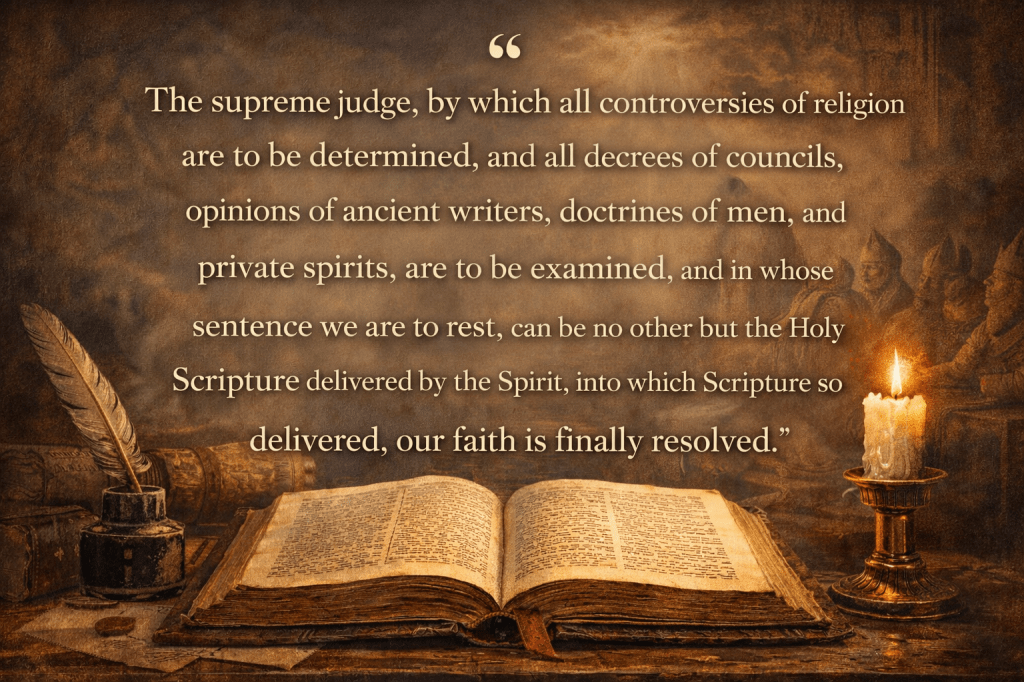
As noted in chapter 1 and the introduction to this series, the doctrine of Scripture does not arise in a vacuum. Throughout the history of the church, controversies of religion have repeatedly forced the church to clarify what she believes, why she believes it, and by what authority those beliefs are established. This part of the series will serve as a supplement to chapter 1, expounding on the final paragraph:
From the earliest centuries, heresy has been the occasion for doctrinal clarity. The ecumenical creeds of the early church, the Apostles’, Nicene, and Athanasian Creeds, together with the Chalcedonian Definition, were not speculative exercises, but careful responses to real theological error. These creeds remain enduring benchmarks of orthodoxy for Trinitarian theology and Christology, and their doctrinal substance is clearly reflected in the 1689 Confession.
What unites these controversies across time is not merely agreement on doctrinal conclusions, but agreement on how those conclusions are reached. Again and again, faithful men stood upon Scripture alone as the final authority in matters of faith and obedience. The following are some brief, but important examples.
Early Witnesses to the Supremacy of Scripture
Irenaeus of Lyons (c. 130–202)
Irenaeus, a disciple of Polycarp, who himself was a disciple of the Apostle John, wrote extensively against Gnostic distortions of the gospel. In defending the faith once delivered to the saints, Irenaeus appealed not to secret knowledge or ecclesiastical novelty, but to the public and written Word of God:
“We have learned from none others the plan of our salvation, than from those through whom the Gospel has come down to us, which they did at one time proclaim in public, and, at a later period, by the will of God, handed down to us in the Scriptures.”
—Against Heresies, 3.1.1
Here, already in the second century, Scripture is identified as the divinely appointed repository of apostolic teaching.
Augustine of Hippo (354–430)
Augustine, arguably the most influential church father for the Reformers, especially Calvin, spoke with remarkable clarity concerning the authority and uniqueness of Scripture:
“It is to the canonical Scriptures alone that I am bound to yield such implicit subjection as to follow their teaching, without admitting the slightest suspicion that in them any mistake or any statement intended to mislead could find a place.”
“He also inspired the Scripture, which is regarded as canonical and of supreme authority, and to which we give credence concerning all the truths we ought to know and yet, of ourselves, are unable to learn.”
—City of God, 11.3
“There is a distinct boundary line separating all productions subsequent to apostolic times from the authoritative canonical books of the Old and New Testaments… In the innumerable books that have been written latterly we may sometimes find the same truth as Scripture, but there is not the same authority. Scripture has a sacredness peculiar to itself.”
—Reply to Faustus, 11.5
Augustine’s position leaves no room for later writings, however helpful, to rival Scripture in authority.
Thomas Aquinas (1225–1274)
The medieval period is often treated as a theological void between the early church and the Reformation. Yet the church did not cease to exist, nor did faithful reflection on Scripture disappear. Thomas Aquinas, while later claimed by Roman Catholic theology, exerted significant influence on the Reformers, particularly in Christological formulation.
“We believe the prophets and apostles because the Lord has been their witness by performing miracles… and we believe the successors of the apostles and prophets only in so far as they tell us those things which the apostles and prophets have left in their writings.”
“Only to those books or writings which are called canonical have I learnt to pay such honour that I firmly believe that none of their authors have erred in composing them.”
Even here, Scripture remains the measuring rod by which all later teaching is judged.
The Reformation Recovery of Sola Scriptura
Martin Luther (1483–1546)
Martin Luther’s stand at the Diet of Worms (1521) remains one of the clearest expressions of the Reformation principle of Sola Scriptura. Confronted with the combined authority of popes and councils, Luther refused to recant unless convinced by Scripture itself:
Unless I am convinced by the testimony of the Scriptures and by clear reason, I am bound by the Scriptures I have quoted. My conscience is captive to the Word of God. I cannot and I will not retract anything, since it is neither safe nor right to go against conscience. May God help me. Amen
For Luther, the Word of God stood above all ecclesiastical power.
William Tyndale (1494–1536)
William Tyndale carried this conviction into the work of translation. By rendering the Scriptures into English from the original languages, he defied Rome’s restriction of Scripture to Latin and clerical control. For this, he was imprisoned and executed. His final prayer—“Lord, open the king of England’s eyes”—became a rallying cry for the English Reformation.
The Marrow Controversy and the Gospel Clarified
Not all controversies arise between rival communions. Some occur within the same confessional tradition. The Marrow Controversy of the early eighteenth century divided the Church of Scotland, a thoroughly Westminsterian body, and bears directly on issues addressed in the 1689 Confession.
The controversy centered on The Marrow of Modern Divinity, a book anonymously authored by “E.F.” (later believed to be Edward Fisher). Written as a dialogue between an antinomian, a legalist, a minister, and a new believer, the book sought to guard the gospel against both legalism and antinomianism.
The dispute erupted after the General Assembly condemned the Auchterarder Creed, which stated:
“It is not sound and orthodox to teach that we must forsake sin in order to our coming to Christ.”
Thomas Boston and the “Marrow Men” opposed this condemnation, arguing that repentance and obedience flow from union with Christ and are not conditions for coming to Him. Faith alone is the instrument of justification; works neither precede nor merit salvation.
Both legalism and antinomianism, they argued, undermine grace. Neonomianism, in particular, effectively turns the New Covenant into a covenant of works. The controversy ultimately pressed the church to clarify the nature of faith, repentance, assurance, and the gospel itself.
“If you tarry ’til you’re better, you will never come at all.”
—Joseph Hart, “Come, Ye Sinners, Poor and Needy”
These concerns are taken up throughout Chapters 11–20 of the 1689 Confession. For a concise modern treatment, see Sinclair Ferguson’s The Whole Christ.
Doctrinal Clarity and Ongoing Controversy
Many theological errors persist not because Scripture is unclear, but because it is mishandled. Consider the following affirmations:
True or False: Jesus Christ is truly God and truly man with one nature.
The 1689 Confession answers clearly:
“Two whole, perfect, and distinct natures were inseparably joined together in one person, without conversion, composition, or confusion; which person is very God and very man, yet one Christ, the only mediator between God and man.”
—1689 LBCF 2.2
True or False: The Father and the Son are coequal, but the Son is eternally subordinate to the Father.
Chalcedonian Definition: “the distinction of natures being by no means taken away by the union, but rather the property of each nature being preserved, and concurring in one Person and one Subsistence, not parted or divided into two persons, but one and the same Son, and only begotten, God the Word, the Lord Jesus Christ”
Jesus must have a truly human will, as the second Adam, subject to temptation, to obey the will of the Father who sent Him. Eternally, in respect to Jesus’s divinity, he does not have a will separate from or subordinate to the Father. The passages that distinguish Jesus’s will from the Father’s must be understood in relation to his humanity.
True or False: We must clean up our lives before coming to Christ in faith.
The Marrow Controversy answers decisively: sinners come to Christ as they are, as sinners, and transformation, even repentance, logically follows union with Him.
Scripture as the Final Judge
These controversies, ancient and modern, demonstrate why Chapter 1 of the 1689 Confession begins where it does. The supreme judge in all matters of religion is not tradition, experience, or ecclesiastical authority, but the Word of God itself.
This article is part of an ongoing series of confessional exposition through the 1689 Second London Baptist Confession of Faith, seeking to recover its theology for the instruction and stability of the modern church.
 Particularly Modern