A recurring impulse in modern Christian political rhetoric is the belief that the remedy for cultural decline is the restoration of past laws—often selectively drawn from colonial America, the early republic, or the mid-20th century. This vision imagines a lost “Christian nation” dismantled by liberalism and waiting to be rebuilt through legislative retrieval.
At first glance, such proposals sound pious, serious, bold, and even practical when not examined for their implications. In reality, they are deeply problematic…biblically, theologically, historically, and pastorally. They rest on a confusion of law and gospel, a flattening of redemptive history, and a romanticized mythology of American greatness that mistakes cultural dominance for Christian faithfulness.
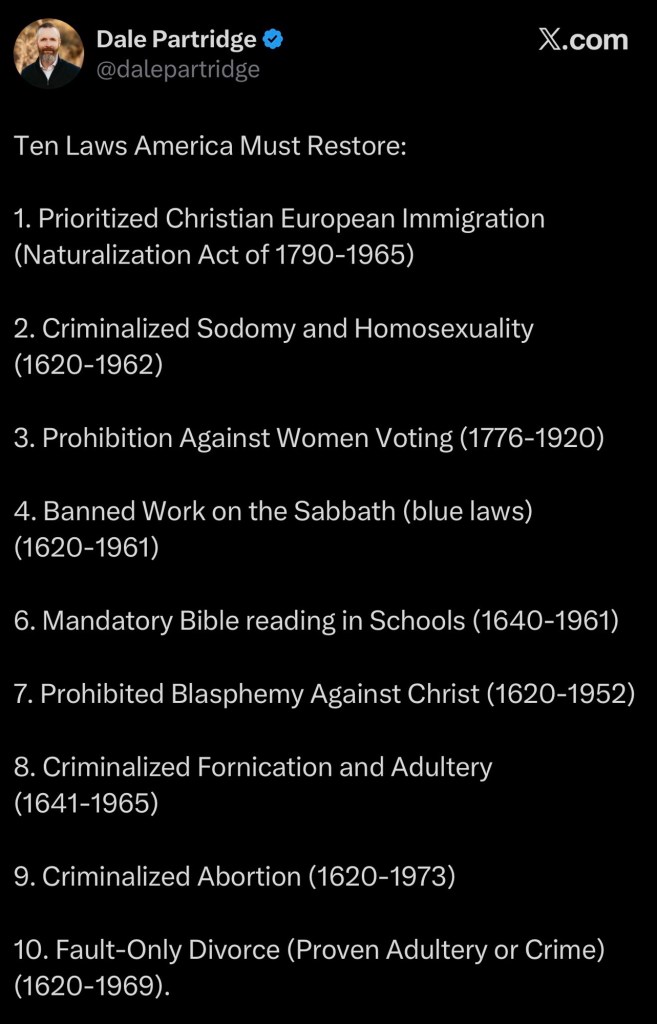
Below, I will address each of the proposed “Ten (nine) Laws America Must Restore,” not to defend modern secularism, but to expose why this entire project is built on worldly grandeur rather than biblical wisdom. My hope is to shed some light on those who are using the degradation of our culture to justify a grasp for power and mistake the recovery of lost influence for the advance of Christ’s kingdom.
1. Prioritized Christian European Immigration (Naturalization Act of 1790–1965)
This proposal confuses covenant identity with ethnic identity. Scripture does not define the people of God by geography, bloodline, or civilizational heritage, but by union with Christ.
The New Testament explicitly dismantles the idea that ethnicity or ancestry confers covenant privilege. To elevate “Christian European” status as a civil ideal is to rebuild the very wall Christ tore down. Even worse, it assumes that Christianity is something inherited rather than confessed. What ever a government decides to impress as their foundation of national identity, even ethnicity, is a nuanced topic subject to much debate, but we should not presume it as inherently Christian.
Biblically, faith is not transmitted through immigration policy. The gospel advances by proclamation, not by border control.
2. Criminalized Sodomy and Homosexuality (1620–1962)
Scripture clearly teaches that sexual immorality is sin. That is not the question.
The problem arises when civil law is made responsible for enforcing repentance rather than order. The New Testament addresses sexual sin primarily through church discipline, exhortation, and gospel proclamation, not through the magistrate. Attaching “Christian” to “Nationalism” inevitably leads to the civil infringing upon the spiritual.
When the state is tasked with policing inward moral conformity, the result is not holiness but hypocrisy. The civil authority bears the sword against violence and injustice, not as a replacement pastorate for an unbelieving populace.
3. Prohibition Against Women Voting (1776–1920)
This proposal reveals how quickly appeals to “biblical order” collapse into cultural traditionalism.
Scripture restricts church office, not civil participation, based on sex. There is no biblical mandate that women be excluded from civic decision-making. “Patriarchalism” is now often pitted against the label of “complementarianism”, thought at its inception as a term was defined in order to combat societal feminism and egalitarianism, not embrace it. The bible gives clear teaching on male headship related to family and church office which should be fervently upheld, but to impose continuity based on assumption rather than exegesis leads to subjective application within the realm of government, business, or really any social structure that contains hierarchy. To argue otherwise is to smuggle patriarchal custom into the Bible and call it divine law; it is retroactive justification of historical power structures.
4. Banned Work on the Sabbath (Blue Laws) (1620–1961)
The Sabbath command was a covenant sign given to Israel, not a universal civil regulation imposed on all nations. Though the Lord’s Day as the Christian Sabbath is in deep need of recovery from most Christians, we need to understand that the first table of the law is reserved for the enforcement of God Himself.
The New Testament consistently treats Sabbath observance as a matter of conscience, not coercion. To enforce rest through civil penalties misunderstands the purpose of the Sabbath, which was always meant to point to Christ, not to function as a productivity regulation for unbelievers. There may be some overlap here in that the rhythm of the world is one of work-rest-work by our very nature, but that is as far as Sabbath in principle transfers to the civil realm.
Rest compelled by magisterial authority is not, and cannot be rest done in faith or worship
5. Mandatory Bible Reading in Schools (1640–1961)
Compulsory exposure to Scripture does not produce conversion. It is chiefly the responsibility of the parents in conjunction with the church as it relates to catechesis and raising children in the nurture and admonition of the Lord. This can certainly be delegated in various ways as long as oversight is maintained, but legal institution often eclipses this function instead of supporting it.
The Word of God is living and powerful, but it is not a talisman. When Scripture is reduced to a civic ritual, it becomes familiar without being feared, quoted without being believed.
Historically, state-mandated Bible reading often functioned as moral formation divorced from gospel proclamation. The result was cultural Christianity, not regenerate churches. Arguably, this is in large part the cause of nominalism today.
6. Prohibited Blasphemy Against Christ (1620–1952)
Blasphemy laws confuse the honor of Christ with the fragility of Christendom.
Christ does not need civil protection. His kingdom advances not by silencing mockers, but by saving them. The apostles endured blasphemy, mockery, and persecution without appealing to Caesar to criminalize speech.
Punishing words does not produce reverence, it produces resentment and false conformity.
7. Criminalized Fornication and Adultery (1641–1965)
Scripture treats sexual immorality as a grave sin, but addresses it primarily through repentance, discipline, and restoration within the church.
When the state criminalizes consensual sexual sin, it takes on a role Scripture never assigns it: moral shepherd of private conscience. This approach assumes a Christian moral consensus that no longer exists and never truly existed in the first place. Many places still have statutes “on the books” for such acts but the legal system would laugh at any attempt of enforcement or adjudication; this is proof positive that legislation, though for the restraint of evil, cannot produce godliness.
The gospel reforms hearts before it reforms habits.
8. Criminalized Abortion (1620–1973)
This is the one category where civil law has a clear and proper interest: the protection of innocent life.
Yet even here, historical appeals are often selective and overstated. Early American law did not consistently articulate a fully developed pro-life ethic as Scripture demands. Moreover, this proposal is weakened, not strengthened, when it is bundled with unrelated culture-war nostalgia.
A biblical case for protecting unborn life must stand on the imago Dei, not on colonial precedent.
9. Fault-Only Divorce (1620–1969)
Scripture permits divorce in limited circumstances, but it never commands the state to adjudicate marriages as a spiritual court.
Civil marriage exists to order society; Christian marriage exists to image Christ and the church. When the state assumes ecclesial authority, it neither preserves marriage nor honors Christ.
The church must recover meaningful discipline long before the state is asked to enforce moral permanence.
The Deeper Problem: A Theology of Worldly Grandeur
We like to romanticize a certain era as a high point of Christian America even though it was marked by racial injustice, nominal Christianity, shallow catechesis, and cultural conformity masquerading as faith. Church attendance was high, but regeneration was thin.
What is mourned is not the loss of Christian fidelity, but the loss of cultural dominance.
At its core, this entire project mistakes external order for spiritual health. It assumes that if the right laws are restored, the nation will be righteous again.
But Scripture teaches the opposite trajectory:
- The church thrives under pressure
- The gospel advances without privilege
- Christ’s kingdom grows through weakness, not control
The New Testament does not call believers to reclaim Rome, but to bear witness within it.
This is not a rejection of moral clarity or civic responsibility. It is a rejection of the illusion that legislation can resurrect a people who have not been born again.
The longing behind these proposals is understandable, but the solution offered is not biblical faithfulness. It is nostalgia baptized as theology.
And nostalgia has never saved a nation.
 Particularly Modern