
In recent years, Joel Webbon has emerged as one of the most vocal critics of what he calls “Judeo-Christianity,” “the post-war consensus,” and the alleged brainwashing of the modern Christian mind. Through social media commentary, podcasts, and platforms associated with Right Response Ministries or NXR Studios, he has advanced a vision of Christian nationalism that increasingly binds Christianity to blood, ancestry, and natural kinship as morally determinative categories.
This post is written not as a personal attack, but as a pastoral and theological warning because the ideas now being promoted are not merely political opinions or sociological observations. They represent a grievous distortion of biblical anthropology, one that, if taken to its logical conclusion,undermines the gospel itself.
Denial of New-Creation Anthropology
At the heart of kinism is a simple but fatal error: it reorders moral obligation according to the flesh.
Scripture does not deny natural relations. Family, nation, and peoplehood are real goods of creation. But in Christ, they are relativized, not absolutized. The New Testament is relentless on this point:
“From now on, therefore, we regard no one according to the flesh” (2 Cor. 5:16).
Kinism does not merely acknowledge natural bonds, it normativizes them. It subtly (or not so subtly) teaches that shared blood establishes stronger, prioritized, or more binding moral duties than shared union with Christ. That is not a secondary political question; it is a direct contradiction of biblical anthropology.
The church is not a spiritual add-on to the natural family. It is a new humanity (Eph. 2:15). The household of faith is not an abstraction layered on top of ethnic loyalty, it is a reconstitution of human identity itself.
Where kin becomes the governing category, the gospel is displaced from the center.
“Real” Men Only
This anthropology does not remain abstract. It produces a distinct vision of manhood, one that is increasingly being held up as “biblical masculinity.”
That masculinity is not defined primarily by:
- sacrificial love,
- cruciform leadership,
- self-giving authority,
- or submission to Christ unto death.
Instead, it is postured as:
- dominance rather than service,
- control rather than responsibility,
- protection of “one’s own” rather than love of neighbor,
- strength measured by boundary-enforcement rather than holiness.
In this framework, masculinity becomes reactive, formed in opposition to perceived threats rather than conformity to Christ. The man is cast not first as shepherd, but as sentinel; not as servant, but as enforcer.
But the New Testament knows nothing of a masculinity that must be defended by appeals to blood, ancestry, or civilizational grievance. Biblical manhood is cruciform before it is confrontational. It is patient before it is powerful. It is willing to lose status, comfort, and even life itself in obedience to Christ.
Any masculinity that cannot survive the command to love enemies is not Christian masculinity at all.
Kinism or Paganism
Ideas must be judged not only by their intentions but by their internal logic.
Taken seriously, kinism leads inevitably to conclusions that Scripture explicitly condemns:
- preferential moral worth grounded in ancestry,
- partiality sanctified as “order,”
- and a church functionally subordinated to natural peoples.
This is not the trajectory of Abrahamic faith. It is the logic of pre-Christian paganism, where blood and soil defined belonging, obligation, and destiny.
Biblically, the direction of redemption moves the opposite way:
- from tribe to nations,
- from nations to Christ,
- from Christ to a gathered people drawn from every nation.
To reverse that flow, by re-centering kin after Christ has come, is not recovery. It is regression.
And notably, pagan societies have always paired this regression with a martial, honor-based masculinity, one obsessed with lineage, legacy, and dominance. Scripture repeatedly confronts and overturns that model, culminating in a crucified King who rules by self-giving love rather than ancestral claim. Even His priesthood is without origin (Hebrews 7:3).
Christian Nationalism and the Sacralization of Nature
Much of this argument is advanced under the banner of Christian nationalism. But the problem is not love of order, law, or even nationhood. The problem is what is being baptized.
When Christian nationalism is built on:
- ancestry as destiny,
- ethnos as moral law,
- or nation as a quasi-redemptive structure,
it ceases to be Christian in any meaningful sense.
The result is not Christ ruling the nations…but nations ruling Christ.
Historically, when the church has fused itself to blood, land, or empire, the gospel has always been the casualty. Scripture never authorizes the sacralization of nature. Nature is ordered, yet subjected to corruption; grace redeems. The two must never be confused. It is the very folly of fallen man that he “worshiped and served the creature more than the Creator, who is blessed for ever. Amen” (Romans 1:25). Ethno-centric Christian nationalism then imputes spiritual significance to biological descent where Christ has broken down such barriers (Colossians 3:11). It takes the providential ordering of nations (Acts 17:26) out of common grace and imposes a moral and spiritual obligation to preserve racial or ethnic distinctiveness, elevating nature over and in opposition to redemptive grace.
And when nature is sacralized, masculinity is inevitably recast as the guardian of that order, turning Christian men away from repentance, humility, and mortification, and toward posturing, suspicion, and constant cultural antagonization.
A Theology of Conspiracy
A final and deeply concerning feature of this movement is its dependence on an unfalsifiable narrative: the so-called “post-war consensus.”
This phrase functions not as historical analysis but as a theological scapegoat, a vague, omnipresent force blamed for every doctrinal, cultural, and moral decline. It explains everything and therefore explains nothing.
Christian theology does not build itself on conspiracy narratives. It builds itself on exegesis, confession, and catholic consensus. When suspicion replaces Scripture as the interpretive lens, theology quickly becomes reactive, paranoid, and unmoored.
This atmosphere also rewards a certain performative masculinity: the man who “sees through the lies”, stands athwart history, and alone possesses clarity while others are “brainwashed.” That posture may feel courageous, but it is spiritually dangerous. Pride thrives where suspicion reigns.
Ironically, the claim to have “escaped brainwashing” often masks a deeper captivity: the substitution of discernment with distrust, and doctrine with diagnosis.
Wise as Serpents, Innocent as Doves
This is not written to score points or to signal virtue. It is written because souls are shaped by these ideas, especially young men seeking courage, purpose, and clarity.
Joel Webbon speaks often of courage, clarity, and conviction. Those virtues are real, but they must be governed by truth. Zeal for order without submission to apostolic doctrine is not strength; it is treachery.
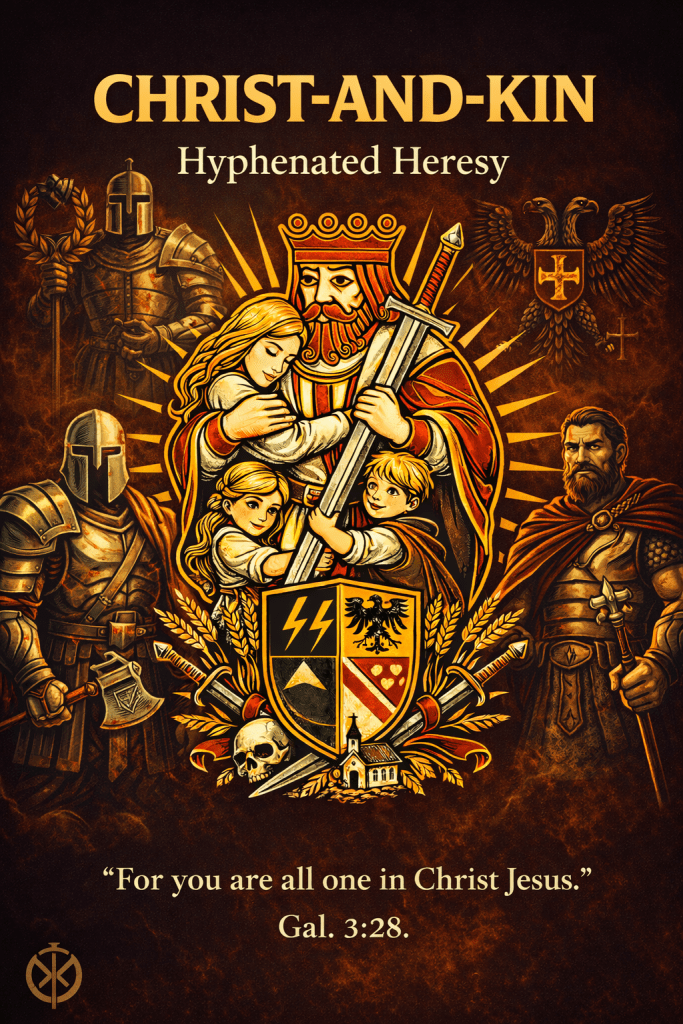
The church does not need Christ-and-kin.
It does not need Christ-and-nation.
It does not need Christ-and-blood.
And it does not need a masculinity forged by grievance and discontent rather than the gospel.
It needs Christ alone, preached without rivals, confessed without supplements, and trusted without fear.
“For you are all one in Christ Jesus” (Gal. 3:28).
That is not post-war liberalism.
That is apostolic Christianity.
And anything that must hyphenate Christ to survive has already confessed its own insufficiency.

 Particularly Modern