
In much of modern evangelicalism, the Lord’s Supper has been reduced to an occasional add-on, something observed quarterly, briefly, and often awkwardly, so as not to interrupt the “main” elements of worship. It is treated as symbolic, personal, and largely optional in its regularity and gravity.
Yet Scripture speaks of the Supper as something received, not merely remembered (1 Cor. 11:23–26). The apostles did not regard it as devotional ornamentation, but as an act of obedience “delivered” by Christ to His church.
The Particular Baptists would not have recognized the modern posture.
For them, the Lord’s Supper was not a devotional accessory. It was a boundary, a confession, and a means appointed by Christ Himself for the nourishment of the church. To mishandle it was not merely poor liturgy, it was doctrinal disorder of the most serious kind (1 Cor. 11:27–30).
A Church-Defining Ordinance
The Lord’s Supper mattered because it defined who the church was.
Paul explicitly ties participation in the Supper to visible unity and mutual accountability: “Because there is one bread, we who are many are one body” (1 Cor. 10:17). The table does not merely express unity, it creates a clear line between the church and the world.
According to the theology summarized in the Second London Baptist Confession (1689), the Supper belongs not to individuals as individuals, but to the gathered church as a visible, covenantal body (cf. Acts 2:41–42). It presupposes baptism (Matt. 28:19), doctrinal agreement (Rom. 16:17), discipline (1 Cor. 5), and pastoral oversight (Heb. 13:17).
One cannot simply “help oneself” to the table without undermining the nature of the church itself.
This is why debates over open vs. closed communion were never trivial squabbles. To fence the table was to obey Paul’s command that the church judge those within (1 Cor. 5:12) and that each participant examine himself rightly (1 Cor. 11:28). To leave it unfenced was to speak a different, and contradictory, ecclesiology.
A Visible Confession of the Gospel
The Supper was also doctrinally declarative.
Paul says that in eating the bread and drinking the cup, the church “proclaims the Lord’s death until he comes” (1 Cor. 11:26). The Supper is therefore not silent. It visibly preaches substitution, sacrifice, and hope of resurrection.
As the church receives the elements together, it confesses:
- Christ’s death was once-for-all (Heb. 10:10–14)
- Salvation is received by faith, not by works (Rom. 3:28)
- Believers are united to Christ and to one another (1 Cor. 10:16–17)
This is why the Particular Baptists insisted that the Supper be administered carefully and intelligibly. A confused table produces confused Christians.
For men like Benjamin Keach, whose catechetical instincts ran deep, the Supper was a visible sermon, Word and sign together, teaching the same gospel preached from the pulpit (Rom. 10:17).
Real Spiritual Presence and the Supper as a Means of Grace
While rejecting Roman Catholic transubstantiation or Lutheran consubstantiation, the Particular Baptists were equally opposed to a bare memorialism that reduced the Supper to mental recollection alone. It is not merely a “remember Jesus” moment.
Scripture speaks of a real participation in Christ, not physically, but spiritually and truly. Paul asks, “The cup of blessing that we bless, is it not a participation in the blood of Christ?” (1 Cor. 10:16). This participation is not automatic, nor tied to the elements themselves, but occurs through faith by the Spirit (John 6:63).
Christ is not corporally present in the bread and wine, but He is really present to believers, who by faith feed upon Him in their hearts. Christ is not brought down to us in the Supper; by the Spirit, we are lifted to commune with Him by faith where He reigns (Col. 3:1; Eph. 1:3; Eph. 2:6).
The Spirit uses the Supper to strengthen faith, confirm assurance, and deepen communion with Christ (John 15:4–5; Eph. 3:16–17).
Thus the Supper is a means of grace, not because it works apart from faith, but because Christ has appointed it as an instrument through which He blesses His people (Luke 22:19; 1 Cor. 11:24–25). As with preaching, the efficacy lies not in the act itself, but in the Spirit applying Christ to the soul (2 Cor. 3:6).
To treat the Supper lightly is therefore not humility, it is neglect of a gift Christ intended for the church’s spiritual health.
Why It Still Isn’t a Side Issue
The modern church’s casual relationship with the Lord’s Supper reveals something deeper than scheduling preferences or logistical concerns during worship. It reveals uncertainty about what the church is, how Christ ministers to His people, and whether He has actually told us how He wishes to be worshiped (John 4:24; Col. 2:20–23).
The reformers understood what we have largely forgotten: you cannot minimize the Supper without minimizing the church itself.
When the table is sidelined, discipline disappears, “go tell him his fault”(Matt. 18:15–20)…”without discerning the body”, membership trends toward meaningless, and worship collapses into private spirituality performed in public.
The Supper was not a side issue because the church was not a side issue. And Christ has not changed His mind (Heb. 13:8).
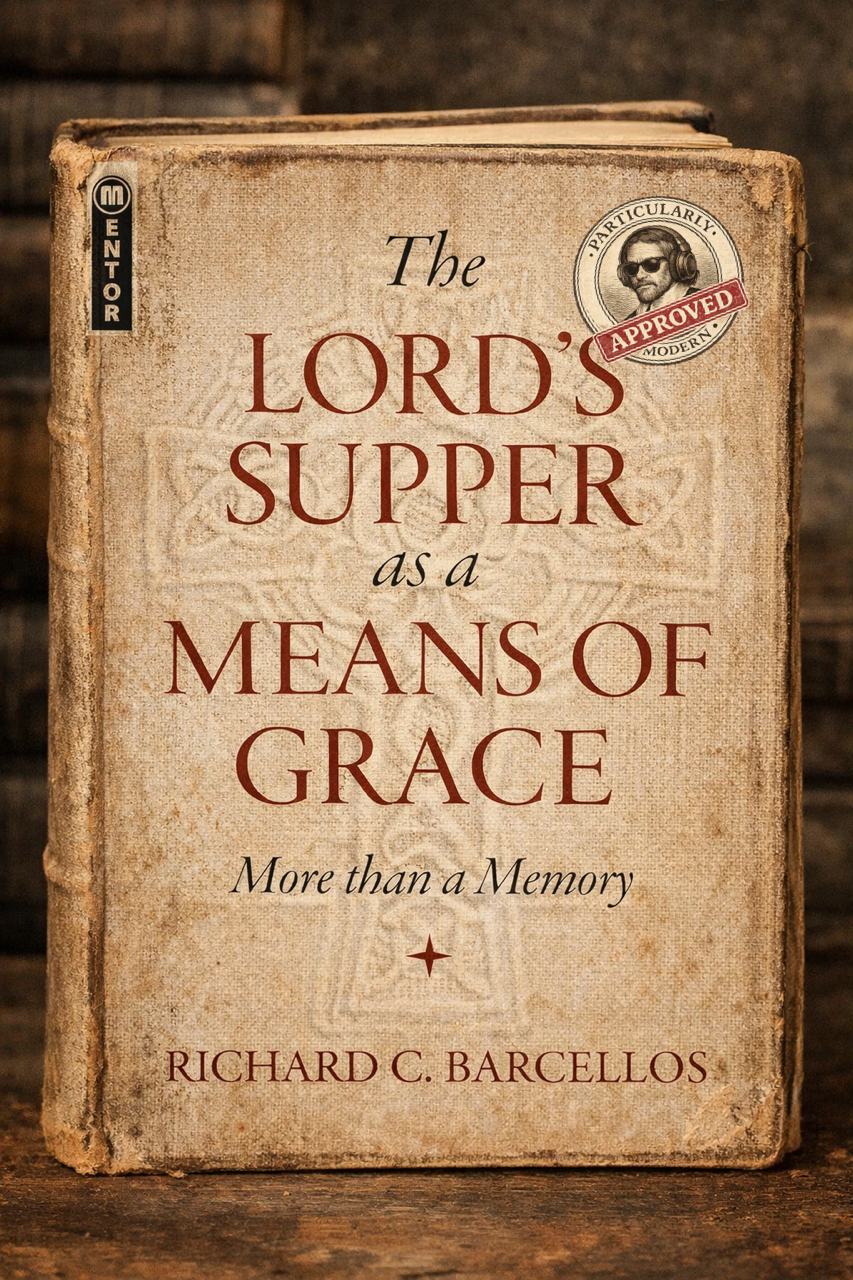
Richard Barcellos’s More Than a Memory is a concise yet deeply rich treatment on this often neglected aspect of our worship.
 Particularly Modern